BLUF
If your brand, website, and offer were built separately, growth usually feels harder than it should. The Synergy Score gives founders a practical way to see whether those parts are actually working together. That matters in a launch or relaunch because disconnected businesses leak trust before a prospect ever buys. When the system is connected, customer confidence rises and growth feels less fragile.
Key points
- The Synergy Score is a 0 to 100 measure of business readiness, not a vanity number.
- It looks at brand identity, digital presence, pricing and offer strategy, and how tightly they connect.
- Strong scores in separate areas do not guarantee trust or growth.
- Connection between pillars is where many businesses either compound or leak.
- Bright Site Builder’s proprietary framework focuses on linking those pillars into one customer experience.
- When the system is aligned, founders spend less time compensating for confusion and more time running the business.
Why this matters for founders launching or relaunching
At launch, every gap costs more. You usually do not have the extra budget, brand recognition, or team capacity to absorb a weak message, a confusing website, or an offer that does not quite land.
That is why some businesses look active but still feel stuck. Traffic comes in. Some leads show up. The service may even be strong. But growth stays inconsistent because the customer journey feels broken across brand, digital, and offer.
The Bright Site Builder proprietary framework
Our proprietary framework helps founders connect brand identity, digital presence, and pricing or offer strategy so the business feels consistent from first impression to purchase and beyond.
That is the Bright Site Builder difference. We are not looking at your logo, website, or pricing in isolation. We are looking at whether each part supports the next one and builds trust across the full customer experience.
The Synergy Score sits inside that approach. It is our proprietary measure of how strong each pillar is and how connected those pillars are in real business terms.
What the Synergy Score measures
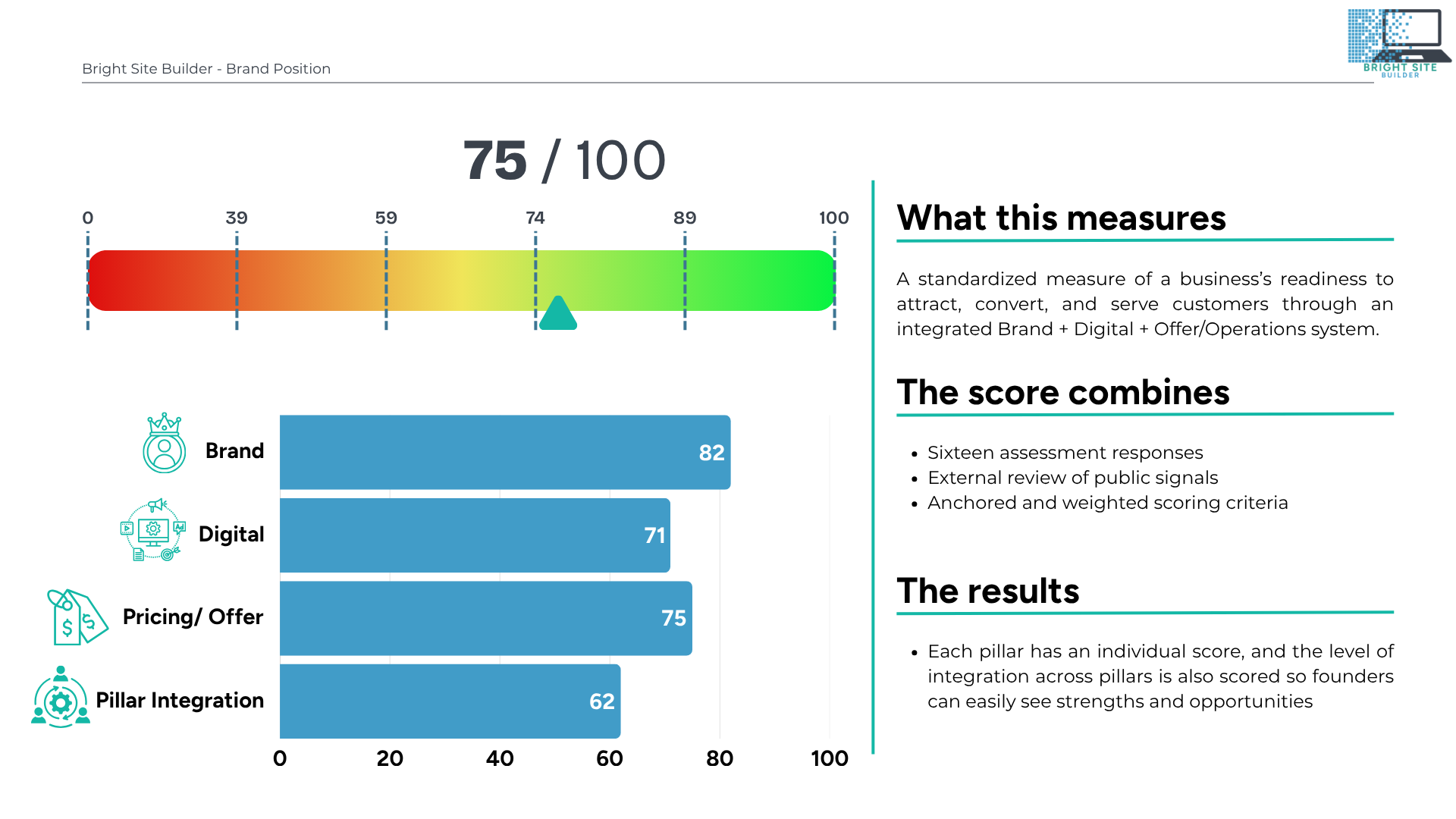
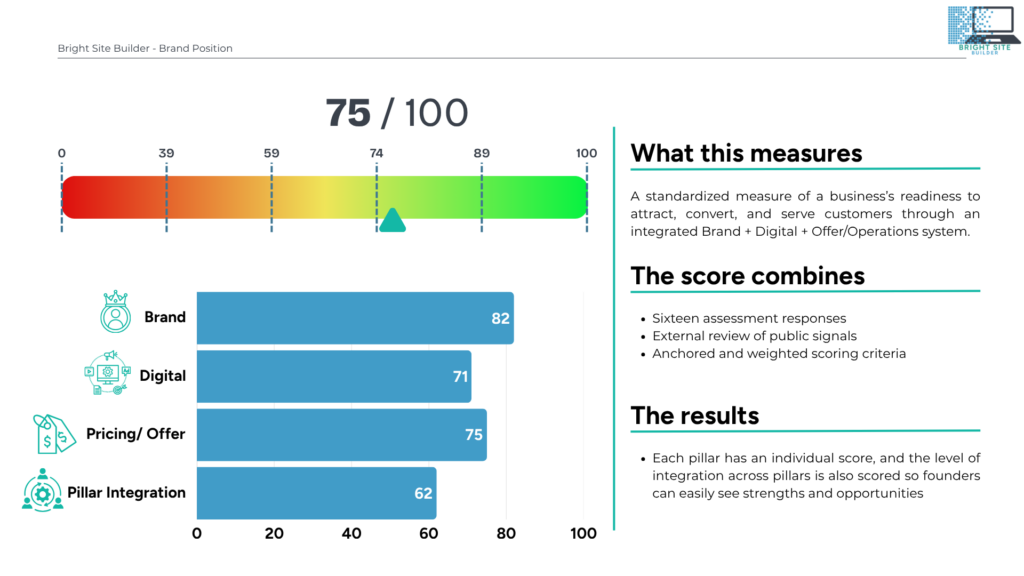
The Synergy Score is a standardized 0 to 100 measure of how ready your business is to attract, convert, and serve customers through one connected system. It looks at three main pillars: brand identity, digital presence, and pricing or offer strategy. Then it scores the connection between them.
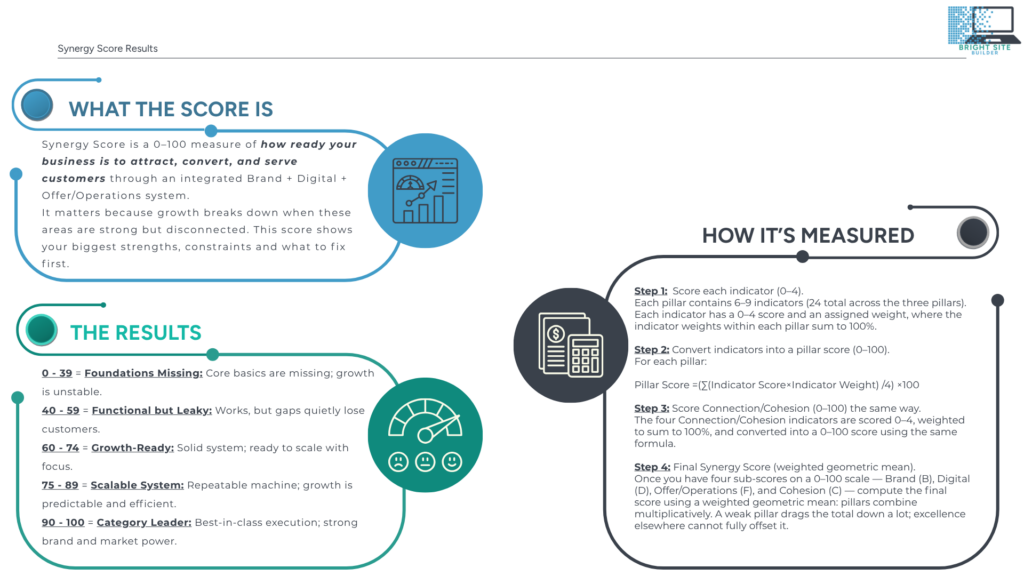
The score combines assessment responses, external review of public signals, and weighted scoring criteria. Each indicator is scored from 0 to 4, then weighted into a pillar score from 0 to 100. The connection layer is scored the same way. The final score is then calculated as a weighted geometric mean across brand, digital presence, pricing or offer strategy, and cohesion. In plain English, one weak area can pull the whole score down.
That matters because the number is not the point. The point is what sits under it. A low score usually means missing foundations or disconnected execution. A mid-range score often means the business works but leaks trust and efficiency. A high score points to a business that feels clear, credible, and easier to buy from.
You can think of the ranges like this:
• 0 to 39: foundations missing
• 40 to 59: functional but leaky
• 60 to 74: growth-ready
• 75 to 89: scalable system
• 90 to 100: category leader
Strong parts are not enough
A lot of founders already have good pieces. The brand may look polished. The website may be live. The offer may be solid. On paper that sounds fine, and establishing each aspect of your business in that order is something we do with our Bright Site Builder Masterplan.
But customers do not experience your business in separate buckets. They experience one flow. If your brand promises premium quality, your website feels generic, and your pricing looks improvised, trust drops. If your website is sharp but the offer is vague, trust drops again. Good parts help, but connection is what multiplies trust.
That is where Bright Site Builder stands apart. We care about the individual pillar scores, but we care just as much about whether those pillars reinforce each other. A business can look decent in each area and still underperform if the connection between them is weak.
When the system is connected, trust compounds
When your brand identity shows up clearly in your digital presence and your pricing or offer strategy, the business starts to feel easier to understand. The customer sees the same logic in your messaging, your website, your pricing, your intake, and your delivery expectations.
That consistency does more than make the business look polished. It lowers doubt. It helps the right customer move forward with more confidence. It also reduces how much manual explanation the founder has to do just to make the business make sense.
This is where growth gets healthier. You can stay focused on your product, service, and operations because the customer experience is not fighting you. Trust is built earlier. Sales conversations get cleaner. Revenue has a better chance of coming from alignment, not constant rescue work.
How founders can apply this in practice
Start by looking at the business the way a prospect sees it. Does your positioning show up clearly on your website? Does your website lead naturally into the offer? Does your pricing feel consistent with the level of trust your brand is trying to create?
Then look at the handoffs. What happens between the first impression and the inquiry? Between the inquiry and the sale? Between the sale and the actual delivery? If those moments feel disconnected, that is usually where trust gets thin.
A practical way to think about it is simple:
• Brand should make your business legible
• Digital should make your business easy to trust and act on
• Pricing and offer strategy should make your business easy to buy
If one of those pieces is out of sync, fix the disconnect before piling on more traffic, more tools, or more campaigns.
Common pitfalls and how to avoid them
One common mistake is treating branding as decoration. A cleaner logo or a nicer color palette will not fix weak positioning. Start with clarity before cosmetics.
Another mistake is assuming visibility equals readiness. A live website or active social account does not mean the business is set up to convert. Make sure the digital layer reduces friction instead of adding it.
A third mistake is underbuilding the offer. Founders often spend heavily on getting attention and then leave pricing, packaging, or sales flow too loose. Tighten the offer so demand turns into revenue worth keeping.
The last mistake is improving one pillar at a time without checking the full journey. When changes are made in isolation, trust breaks in the gaps. Review the business as one system, not a stack of tasks.
FAQs
Why does this matter for new launches?
Because early-stage businesses cannot afford much drag. If your message is unclear or your offer feels disconnected from your digital presence, trust breaks fast and every lead costs more.
How is this different from generic advice online?
Generic advice usually looks at one problem at a time. The Synergy Score looks at how brand identity, digital presence, and pricing or offer strategy work together, which is closer to how customers actually experience a business.
How can this help my local service business?
Local service businesses often compete in crowded markets where trust decides a lot. When your brand, website, and offer feel connected, customers have an easier time believing you, comparing you, and taking the next step.
What if my scores are strong in each pillar?
That is a good start, but it is not the full story. You still need the pillars to reinforce each other. Strong individual scores with weak cohesion can still create a customer journey that feels uneven.
Does a lower score mean the business is failing?
No. It usually means the business has clear places to strengthen. The score is a decision tool, not a label.
What should a founder do first after seeing the score?
Look for the weakest connection, not just the weakest standalone pillar. The biggest gains often come from fixing where brand, digital, and pricing or offer strategy stop supporting one another.
Next step would be turning this into a website-ready version with a slug, excerpt, and on-page SEO fields.