BLUF
The Bright Builder Masterplan exists because launching a business is hard, and most “busy” launches still stall because the brand, website, and offer were never aligned in the first place.
Bright Site Builder’s proprietary framework (the Bright Builder Masterplan) gives you an advantage by forcing that alignment early, before you sink time into redoing messaging, pages, pricing, or promises.
It’s not the only way to launch, but it’s a clean way to unify your business around one clear brand promise, then build the digital and operational reality to match it. With the Bright Builder Masterplan, you can ensure your launch is strategically sound.
Key points
- “Busy” can still mean misaligned, and misalignment usually shows up later as expensive rework.
- Consistency across your website, pricing, and marketing acts like a trust signal, not a design preference.
- The Bright Builder Masterplan is an alignment-first launch process that links identity, customer clarity, digital presence, and pricing/operations.
- The order matters: front-load identity and customer definition so you don’t rebuild everything after you go live.
- Treat your website as your “digital home,” built to earn trust and support real actions like booking or buying.
- Use strategy blueprints and “promise vs capacity” guardrails so growth doesn’t break the experience you’re selling.
Why this matters for founders launching or relaunching
Most early-stage launches don’t fail because founders are lazy. They fail because founders are sprinting in five directions at once.
From the outside, it looks like progress. Logo. domain. socials. a quick site.
Then a few months later, the same founder is rewriting the messaging, rebuilding key pages, and changing prices twice because early customers push back or conversion is soft.
That’s the real tax: rework. It steals time-to-market and confidence.
The root cause is usually simple. The brand, the digital presence, and the way the business makes money were never truly aligned.
So every new “tactic” turns into another patch on top of a shaky foundation.
Consistency across brand and experience is also supported by long-standing research in signaling theory, where alignment reduces perceived risk and increases trust.
The Bright Builder Masterplan Framework
Bright Site Builder’s proprietary framework is the Bright Builder Masterplan.
In simple terms, it’s an alignment-first launch process that links your identity, your customer, your digital presence, and your pricing/operations before you scale marketing.
It’s built around one idea: you can’t treat brand, website, and operations as separate projects. They’re three faces of the same promise.
The framework follows a specific sequence:
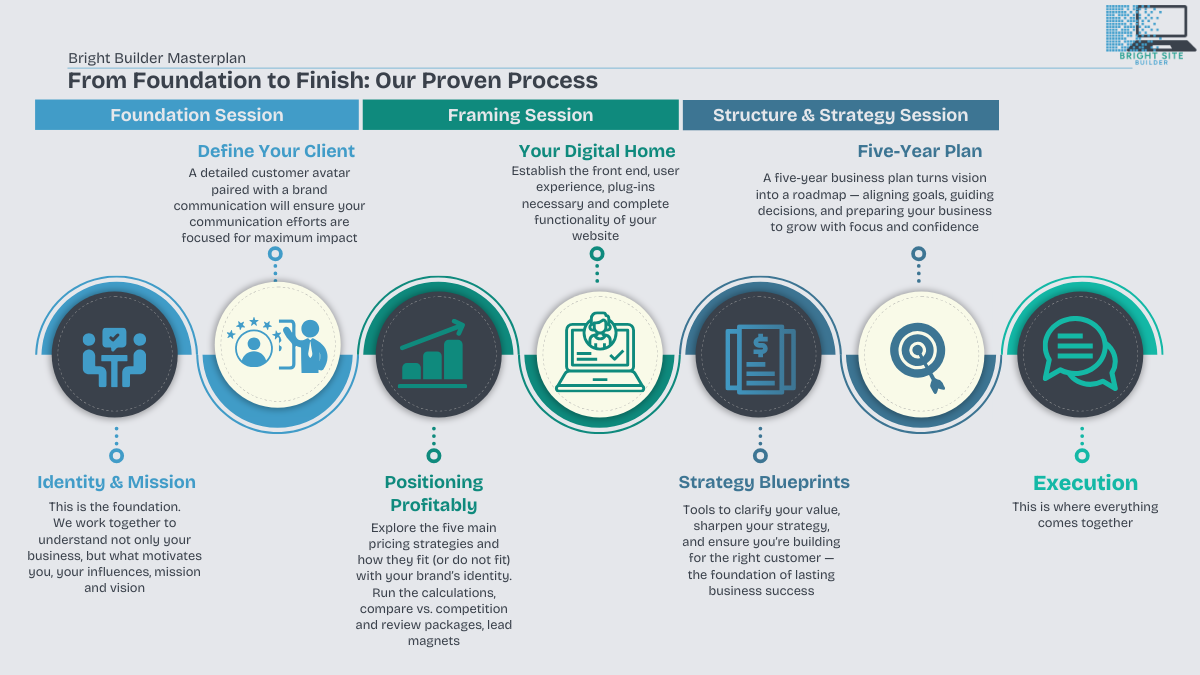
Foundation Session (Identity & Mission → Define Your Client), then Framing Session (Positioning Profitably → Your Digital Home), then Structure & Strategy (Strategy Blueprints → Five-Year Plan → Execution).
That sequence isn’t random. The point is early “pre-development” work has an outsized impact on outcomes, and front-loading definition reduces downstream reversals.
It also bakes trust into your “digital home” from day one by treating the site as a working system, not a placeholder.
Launching is hard, so get every advantage
Founders don’t need another “just post more content” pep talk. Launching and maintaining a business is difficult and the odds really do feel stacked.
What helps is giving yourself advantages that compound. One of the biggest is alignment.
If you rush into visible activity without alignment, you lock in rework.
You end up in the loop: new site, weak conversion, change offer and price, rebuild the site again.
This is where the Masterplan framework earns its keep. It unifies your company around your brand promise first, then builds the rest to match.
Not the only way to launch, but it’s a real advantage because it stops you from building seven disconnected “launch projects” that don’t reinforce each other.
Consistent values build trust everywhere
Businesses are a lot like people here. You trust someone more when they show up the same way in different situations.
Your customers do the same thing with your business. They compare your website, your pricing, your social content, your sales process, and the actual experience. When it all lines up, it feels safer to buy.
To be blunt: message consistency across channels has a direct effect on brand trust and loyalty.
So “consistency” isn’t just matching colors. It’s making sure your values and promises show up the same way in different arenas.
A simple example:
- If you say you’re premium, your pricing, policies, and customer experience need to look premium too.
- If you say you’re the fastest option, your booking flow and response times need to back that up.
In service businesses especially, the experience is the brand.
So your “values” can’t live only in copy. They have to show up in delivery, and that means your internal capability matters.
The order matters as much as the framework
A lot of founders try to build the website first because it feels productive. Then they “figure out messaging.” Then they revisit pricing. Then they realize they don’t actually want to serve the people showing up.
That sequence guarantees rework.
The Masterplan flips it: define identity and mission, define your client, then move into positioning, pricing, and your digital home.
Here's the why: the sequence isn’t arbitrary, and early definition work reduces rebuilds later.
Here’s how the step order protects you:
Step 1 and 2 (Identity, mission, and client) stop you from building “pretty” assets that don’t say anything clear. The Foundation Session forces you to define purpose, guardrails, voice, and how identity translates into behavior.
It also forces you to choose who you serve so your messaging doesn’t try to speak to everyone at once.
Step 3 and 4 (Positioning and digital home) stop the common mismatch where the offer and pricing don’t fit the brand promise, or the site looks good but doesn’t earn trust.
Step 5 to 7 (Blueprints, planning, execution) stop “channel drift,” where your website says one thing and your social presence turns into something else.
It also adds the guardrails that keep you from promising what you can’t deliver when demand spikes.
How founders can apply this in practice
You don’t need a 40-page brand doc to start. You do need a clear order of operations.
Here’s a founder-friendly way to apply the Masterplan logic:
- Write down your non-negotiables. What do you stand for, and what will you not do even for revenue? This maps to the “values and guardrails” idea in the Foundation Session.
- Pick a real primary customer. Not “everyone who needs this.” Choose one main segment and get clear on their language, triggers, and objections.
- Define positioning in outcomes, not features. Your value prop should reflect what your chosen customer actually cares about.
- Set pricing that matches both your promise and your unit economics. Don't fall into the common founder trap of copying competitors or cost-plus pricing, then scrambling later.
- Build your website like a real “digital home.” Make it usable, credible, and operationally complete, with clear routes to contact, policies, and friction-free core flows.
- Create channel translation rules. Decide how your identity and offer show up on your site, on Google, on social, and in proposals so the story stays consistent.
- Add “promise vs capacity” guardrails. Put in writing what you can deliver now, what you can’t deliver yet, and what ships first.
If you do nothing else, steal this line and use it as your filter: don’t confuse activity with alignment.
Common pitfalls and how to avoid them
Pitfall 1: Your promise outruns your delivery
If marketing paints a picture that operations can’t support, customers feel the gap fast.
Avoid it by writing down “promise vs capacity” limits before you scale anything.
Pitfall 2: Every channel tells a different story
If your website, social, and sales conversations drift, customers struggle to understand who you are.
Avoid it with a simple messaging system and channel translation rules.
Pitfall 3: Pricing floats disconnected from value
Pricing high without the credibility and delivery to back it up compresses margins and creates constant pushback.
Avoid it by tying pricing to outcomes and making sure the experience supports the position you’re claiming.
Pitfall 4: Your site looks nice, but doesn’t feel trustworthy
A site that lacks basic trust cues can undermine willingness to transact.
Avoid it by building the “digital home” as a working system, not a design project.
FAQs
Why does this matter for new launches?
Because most early mistakes show up later as rework: rewriting messaging, rebuilding pages, changing prices, and pulling back promises you can’t deliver.
An alignment-first approach reduces those reversals by forcing the hard decisions earlier.
How is this different from generic launch advice online?
A lot of advice starts with tactics: post more, run ads, build a quick site. The Masterplan starts with alignment across identity, customer, digital presence, and pricing/operations, then it moves outward.
It also treats the sequence as part of the strategy, not a nice-to-have.
How can this help my local service business specifically?
For local services, the “experience is the brand,” so your delivery and operations shape what customers believe about you.
Your website also needs to work like a real digital home, with clear booking or contact paths and trust scaffolding built in.
What if I run an e-commerce business?
The same alignment rules apply, just with different “trust moments.” Checkout reliability, shipping clarity, and visible support options matter because customers decide quickly whether they trust your site enough to pay.
If your positioning and pricing don’t match the experience, you’ll see it in conversion and repeat purchase behavior.
What if I don’t have a big budget?
A smaller budget makes alignment more valuable, not less, because you can’t afford to build everything twice. The “busy launch” examples are mostly time drains, not big-agency problems.
Nail the order: identity and client clarity first, then positioning, then a credible digital home.
Do I really need the full framework, or can I use parts of it?
You can use it as a diagnostic tool. The article even gives a simple checklist approach: can someone explain what you do, does pricing reflect positioning, does the site feel credible, and can you deliver what you promise.
The closer you stick to the sequence, the less rework you invite.